What quantum computing could mean for insurance
Notes from the Quantum-AI session at CES Unveiled Europe in Amsterdam
29 October 2025Category: Insights
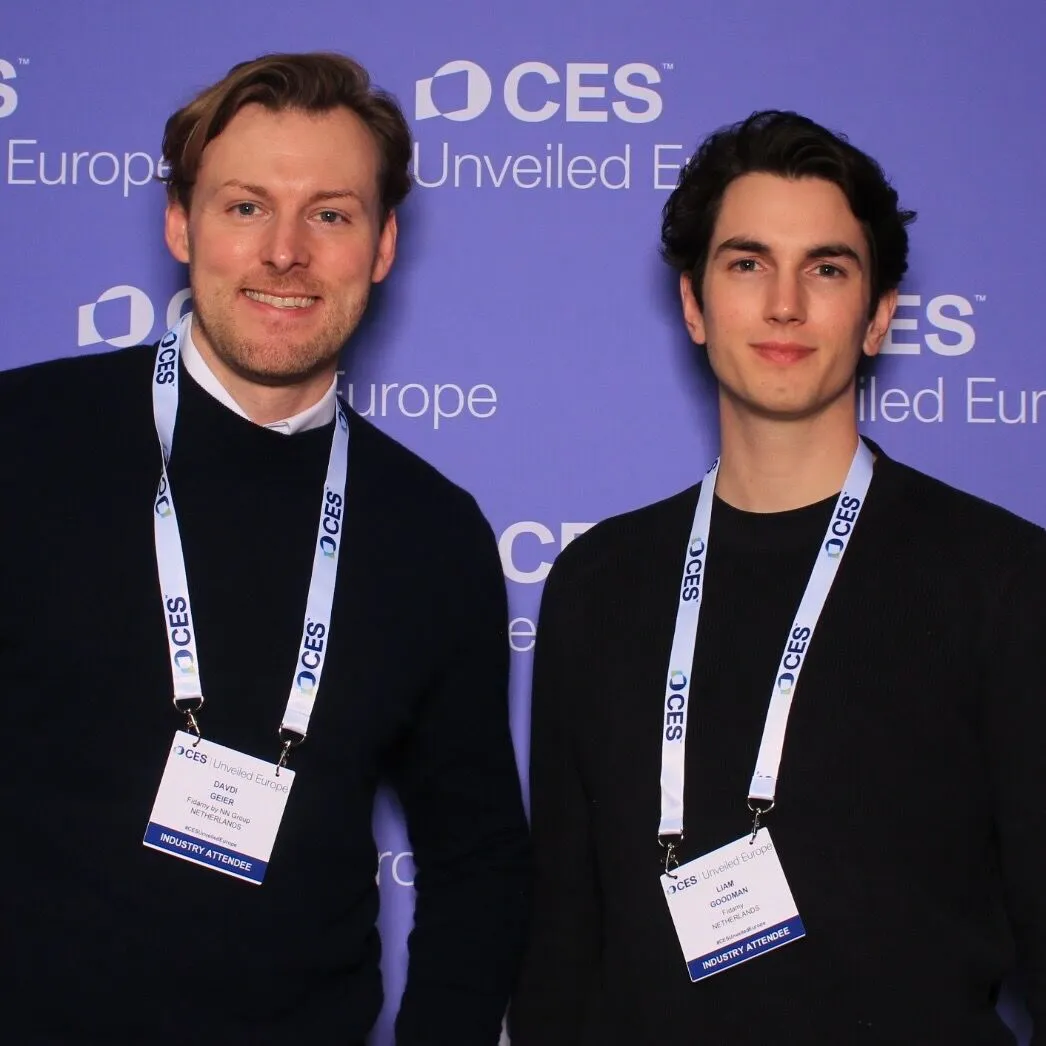
On 28 October, David Geier and I spent the day at CES Unveiled Europe at the Beurs van Berlage in Amsterdam. It is the European stop on the road to CES in Las Vegas, with more than 50 start-ups from over a dozen countries and an audience of industry leaders, investors and policymakers.
Events like this are a reminder of how quickly technology moves, and how much opportunity that creates for companies that build lean. Work that used to take hundreds of people can now be orchestrated by a handful, because the technology curve keeps getting steeper. CES Unveiled was full of that momentum: tools and systems that push automation, intelligence and adaptability further, so that lean companies can operate like giants.
The Quantum-AI session
The highlight for me was the Quantum-AI session hosted by Quantum Delta NL, the foundation behind the Netherlands' national quantum technology programme. In 90 minutes, speakers from Quantum Delta NL, KPMG, Fermioniq, Pasqal, OVHcloud and CES GovTech covered innovation trends, technical progress and the policy choices Europe faces. Three takeaways stood out.
1. AI is pulling quantum forward
The AI boom is driving a wave of investment and progress in quantum computing. The two fields are converging.
2. Quantum-inspired methods already work
You don't need a quantum computer to benefit today. Quantum-inspired algorithms, which borrow ideas from quantum computing but run on classical hardware, are already delivering measurable results.
3. The breakthrough phase is six to ten years away
Quantum computing is approaching a major breakthrough phase within the next six to ten years. Those who start building early will shape what happens at the edge.
What it means for insurance
Insurance is the business of quantifying uncertainty, and much of that work runs on simulation: thousands or millions of scenarios to price a risk, stress-test a portfolio or set capital requirements.
Quantum computing could change the scale of that work. It promises the ability to simulate complex, path-dependent risks, to explore rich scenarios dynamically and to optimise portfolios at a level that is out of reach today. Monte Carlo simulation, the workhorse of risk modelling, is one of the areas where quantum algorithms offer a known theoretical speed-up.
I see this as the next step in how insurers quantify and manage uncertainty. For a lean company like Fidamy, the lesson is the same as with AI: build on modern foundations, stay close to the research and be ready to adopt new tools as they mature.
Thank you
Thanks to Quantum Delta NL for organising, and to Ulrich Mans, Ton van 't Noordende, Daniël van der Kolk, Jörgen Sandig, Krisztian Benyo, Fanny Bouton, Donald Upson, Philippe Bouyer and Job Nijs for sharing their insights.